
The Night When Destiny Slipped and Dhoni Stole It Back
Kolkata. March 23, 2016.
Under the murky floodlights of the M. Chinnaswamy Stadium in Bengaluru, the air was heavy, not only with humidity but also with anticipation. India was at the edge. One billion hearts were pounding like a drum roll, a nation prayed, and a lone man, composed behind the stumps, was poised to determine destiny with a dash and a solitary glove.
This was not another day at the cricket ground. This was India playing Bangladesh in the T20 World Cup 2016, a match that was done and dusted until it wasn’t.
The Setup: A Must-Win Clash
For India, the situation could not have been more desperate. Having lost their first match already to New Zealand, each subsequent match was akin to a knockout. Bangladesh, however, were not afraid. They had grown stronger with each year, beating giant teams and gaining respect on the cricketing pitch all around the globe. They were no longer the underdogs anymore.
India arrived with the baggage of expectation. Virat Kohli was sublime, Yuvraj Singh seemed inspired, and Mahendra Singh Dhoni, as ever, seemed poised. But the Bengaluru pitch threatened runs, and T20 cricket has a nasty habit of turning the best-laid plans on their head.
India’s Batting: A Struggle for Momentum
Once India were sent in to bat, their start couldn’t have been worse. Rohit Sharma and Shikhar Dhawan were dismissed early on. The
Bangladesh’s bowlers, headed by the young Mustafizur Rahman, bowled with searing discipline. Their cutters bit the surface, and each dot ball weighed heavier than the previous one. Indian batsmen struggled to score boundaries, and the innings never really gained momentum.
By the end of 20 overs, India managed to reach 146 for 7. It was a modest total, especially on a small ground like the Chinnaswamy. The crowd clapped politely, but everyone knew that this might not be enough. Even Dhoni’s expression, usually unreadable, showed a hint of concern.
Bangladesh’s Chase: Calm Before the Storm
When Bangladesh batted, they did so with surprising composure. Tamim Iqbal, Bangladesh’s dashing opener, batted with authority, smashing the ball sweetly and driving it through the gaps. The Indian bowlers attempted to disrupt the rhythm but Bangladesh kept the scoring going.
India’s spinners, Ravichandran Ashwin and Ravindra Jadeja, attempted to put pressure. For a short while, it worked as wickets fell in between, but Bangladesh remained in touch with the required rate at all times.
The scoreboard was at 100 for 3 after the 15th over. They had 47 runs to make from 30 balls, which in T20 cricket is usually routine if you keep your nerve.
But this was India vs. Bangladesh, a clash loaded with history, pride, and emotion. Nothing on this night was going to be routine.
The Drama Starts
With every over, tension in the stadium mounted. By the 18th over, Bangladesh were 133 for 6, and they required only 13 runs off 12 balls. The Indian crowd was quiet. Most had already given up hope.
At the field, though, Dhoni was the boss. He summoned his bowlers, addressed them softly, and reshuffled his field with precision. His thoughts were racing ahead of everyone’s. He confronted Hardik Pandya, a young all-rounder with barely a few years of international cricket under his belt.
You bowl the last over,” Dhoni instructed him. Pandya nodded anxiously. He never knew that he was to bowl the most dramatic six balls of his life.
The Final Over: 11 Needed From 6 Balls
Bangladesh were 11 runs short of the target off the final over. Experienced wicketkeeper Mushfiqur Rahim and finisher Mahmudullah Riyad were at the crease. The Bangladesh dugout was hopeful. The Indian public was gasping.
Ball 1:
Pandya came in and bowled a slower one. It was mistimed and was hit for a single. Ten runs required from five deliveries.
Ball 2:
Pandya bowled short, and Rahim cut it aggressively behind point for four. The Bangladesh supporters went wild. Six required from four.
Ball 3:
Another more complete delivery, pulled past square leg, and another four. The Bangladesh dugout was standing on its feet. Only two runs were required from three deliveries.
Rahim lifted his bat and rejoiced prematurely. The smile, the gesture, the confidence — all looked like a win. But little did he realize, fate had a surprise left in store.
Never Celebrate Too Early
As the lens was focused on Dhoni, he remained motionless. No expression. Simply focused silence. He adjusted Jadeja a bit deeper at midwicket. He knew cricket is a brutal sense of humor.
Ball 4:
Pandya used a fuller ball, Rahim attempted to scoop it over fine leg but did not hit well. The ball was sent high in the air. Shikhar Dhawan settled under it and took a safe catch.
Rahim was heartbroken. Two runs were required off two balls.
The pressure had come back, heavier than before.
Ball 5: The Collapse Continues
Mahmudullah, the most reliable of Bangladesh batsmen, was on strike. They just needed one clean stroke.
Pandya attempted the yorker, Mahmudullah swung forcefully, and the ball shot straight up. Ravindra Jadeja was waiting at long-on, cool and composed. He took it cleanly.
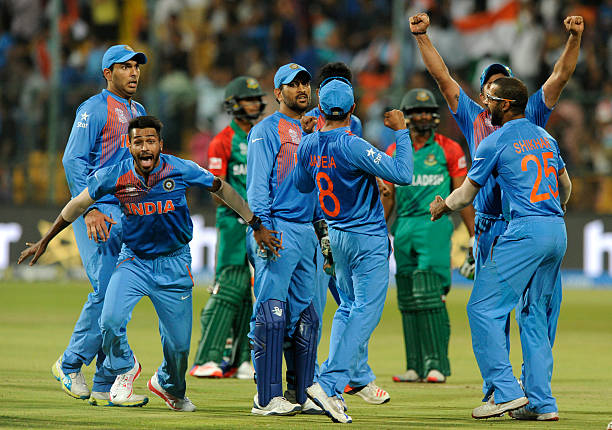
The audience went wild. Pandya was swamped by his teammates. Kohli shouted with excitement. Bangladesh could not believe what they were witnessing.
Two runs were now required off the last ball with a single wicket left.
The Last Ball: The Dash That Stopped Time
Shuvagata Hom was on strike. Mustafizur Rahman was at the non-striker’s end.
Pandya took the run for the final delivery. It was a short and wide delivery outside off stump. Hom swung and missed. The batsmen ran a single. They turned for the second, longing for glory.
Dhoni picked the ball cleanly, but he had taken off one glove already. He began running towards the stumps at lightning pace. Mustafizur was running too, attempting to reach home.
Dhoni dove and shattered the stumps in a split second.
The bails went flying. The stadium erupted.
“Dhoni removes the glove, collects, and smashes! India wins by a single run!” bellowed Ravi Shastri in the commentary box.
It was one of the most legendary conclusions in T20 history.
The Aftermath: Relief and Heartbreak
As the dust cleared, players collapsed on to the ground. Some in disbelief, others in relief. Pandya hugged by teammates, Kohli embraced Dhoni, and the captain just smiled, his serene face masking the mayhem around him.
The Bangladesh players were devastated. They had the victory in their hands. Two runs short. Two easy runs. But it was not to be.
The cameras showed Dhoni walking off quietly, expressionless, as if nothing extraordinary had happened. But for everyone watching, it was a moment frozen in time.
The Numbers Behind the Madness
Bangladesh finished with 145 for 9, losing by a single run. India’s bowlers shared the wickets among themselves, but it was Hardik Pandya’s final over and Dhoni’s brilliance that stole the show.
Dhoni’s run-out was clocked at lightning speed. From the moment he gathered the ball to breaking the stumps, it took less than a second. That single action defined the match and became one of the most replayed moments in cricket history.
The Reactions: Shock and Awe
Social media went into overdrive in seconds. The fans named it “The Heist in Bengaluru.” Hashtags trended all over India. Commentators labeled it as one of the greatest getaways in T20 World Cup history.
Bangladesh’s Mushfiqur Rahim subsequently tweeted, saying sorry for premature celebration. It was a humble moment that reflected how much the game meant to the player and his team. The match turned out to be a lesson that every cricketer would learn — never celebrate until the final run is made.
Dhoni: The Calm in the Chaos
When questioned post-match what was running in his mind, Dhoni, typically so calm and understated, replied, “Nothing much. I was waiting for the ball to arrive. I knew it was a one-in-a-hundred opportunity. You have to trust your instincts.
That is what set him apart. When others panicked, he remained ice-cool. He did not throw the ball; he ran with it, relying on his speed and accuracy. It was that faith and certainty in a crisis that made him a legend.
Bangladesh: The Agony of Inches
For Bangladesh, there was to be heartbreak for years to come. They had played magnificently, with India matching them in all departments. But the pressure of the last few moments got the better of them.
They had two runs to go, yet so close. That evening was a sore memory, replayed and relived on television and in the minds of the fans time and again. But it also indicated how far Bangladesh cricket had evolved — from being underestimated to very nearly bringing down a giant.
The Symbolism: More Than Just a Game
This game was more than a cricket match. It was a tale of faith, patience, and the bitter poetry of sport. Bangladesh demonstrated their promise, and India why experience and calm are everything.
It reminded one that cricket is not simply runs or wickets, but emotion, control, and timing.
The Legacy of “2 Runs Too Far”
Years later, people still talk about that night. It was not a final, nor a semifinal, but it had everything a classic needs — drama, despair, redemption, and glory.
For Indian fans, it was one of Dhoni’s finest moments as captain. For Bangladesh fans, it was a heartbreak that strengthened their resolve.
Even now, that picture of Dhoni running with the glove in one hand and the ball in the other remains an icon of leadership, composure, and sheer genius.
The Final Word
Cricket is referred to as the game of glorious uncertainties for good reason. At times it is not about centuries or humongous totals. At times it is about a run, a decision, or a sprint.
When Mustafizur Rahman dove for that second run, and Dhoni rushed towards the stumps, time froze. The whole stadium held its breath as the bails flashed, and history was created.
In one moment, a billion people regained their breath. In one second, a match was turned into a legend.
“2 Runs Too Far” is not the tale of a game. It is a tale of faith, coolness, heartache, and bravery. It serves as a reminder that in cricket, and in life, nothing is done until the last ball.
For More Blogs Visit